Jude Bellingham, the chisel of chaos
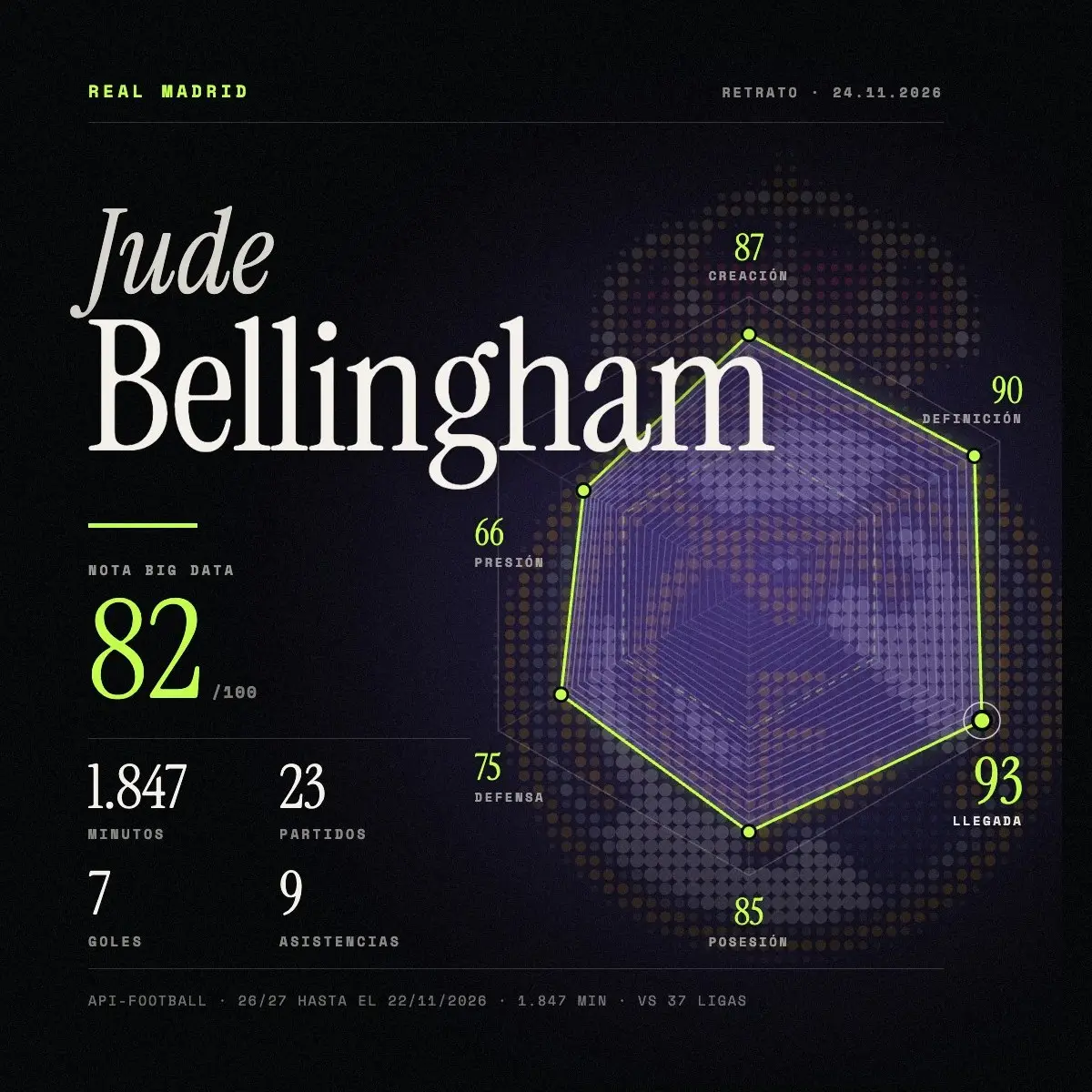
He came on at half-time with Madrid behind against PSV and sculpted the night: the 2-1, on the volley, and the pass for the fifth. Bellingham does not play football; he carves it.

Magical nights at the Bernabéu are no longer written: they are sculpted, ever since Jude Bellingham pulled on the Real Madrid shirt. On Tuesday he showed once again that he is going through one of the best spells of his career and that, when we look back, we will remember him as one of the great footballers of this generation. He is an artist, a bohemian from another time, a sixteenth-century sculptor. Because he is a genius, and geniuses do not create out of will, but out of need: it is their way of speaking to the world. For Bellingham, art is a calling. He does not ration, he does not measure; he acts on instinct alone, one that drives him to sign unrepeatable goals and moves. Iconic ones.
Geniuses do not create out of will, but out of need
A bouncing ball reaches him on the edge of the box. An awkward one. Any other mind would try to bring it down, settle it and start again. But Jude is not one of those who sit and correct their words: he lets them out. And, just as it comes, he caresses it and leaves it suspended in the orbit of a right leg painted in oil on canvas. The spectator is taken aback; he is witnessing something only the great sculptors are able to provoke. And the strike is the summit. The ball leaves his foot as if obeying an order and taking pains to carry it out for whoever sent it. It kisses the post and the net wraps it up with the tenderness of Michelangelo putting the final touch to his David. Then come those five seconds in which the artist puts down the chisel and silently shows off his work. Bellingham is not the master of his destiny. He is the protagonist of his world.
Michelangelo left it written in sonnet 151 of his Rime: the finest artist conceives no form that a block of marble does not already hold within, beneath what is superfluous, and the only thing that reaches it is "the hand that obeys the intellect". For the Florentine, sculpting was not adding but taking away. The figure had always been asleep in the rock, waiting for someone able to see it, and the craft consisted of freeing it chip by chip, of tearing from the stone everything that was not David. The dust stays on the workshop floor; what remains is eternal. In Bellingham, instinct is intellect. He came on at half-time with Madrid behind against PSV, on a dense, unhewn night, and began to chisel. He volleyed the 2-1 in the 60th minute and still had time to gift Vinícius the fifth goal of a 5-1 that, at half-time, nobody saw coming. He invented nothing the match did not already carry inside: he simply saw it before everyone else. The Bernabéu was a block of chaos, and he stripped away all the excess until the figure came into view. Because there are footballers who play matches and others who carve them. And Jude, like Michelangelo before the Carrara marble, already knows what lies inside before striking the first blow.
Data: API-Football, Real Madrid 5-1 PSV Eindhoven (Champions League, 24/11/2026). Sonnet: Michelangelo, Rime, 151 (c. 1538-1544); translation by Al Primer Toque.