Tijjani Reijnders, the first of a new species
Cast aside at City and left on the bench the day Morocco knocked the Oranje out of the World Cup, Tijjani Reijnders now leads Xavi's Netherlands from Saudi Arabia.

There is no denying that football's paradigm has shifted. It evolves or regresses, depending on who is watching, and commercialisation now drives both the advances and the setbacks of the game's globalisation. In recent years, several countries have tried to carve out a place in the business of the ball as a way of diversifying their economies and securing new sources of income.
China was the loudest example. In 2016 its federation unveiled a plan to turn the country into a football superpower by 2050, with the aim of hosting a World Cup and winning it. The big conglomerates, many of them built on property, took the hint and the Super League filled up with stars: Hulk, Jackson Martínez, Alex Teixeira and, in January 2017, Oscar, who cost 60 million euros, an Asian record. Six months later the state itself cooled the fever with a 100% levy on every foreign signing. The pandemic and the collapse of the property market did the rest: Jiangsu Suning vanished in 2021 with their first league title barely won, and Guangzhou Evergrande, twice champions of Asia, went down in 2022 unable to pay their wages. The national team has not played at a World Cup since 2002, and Li Tie, its former head coach, is serving twenty years in prison for corruption. The money bought names, but it built neither a fan base, nor an academy, nor a competition able to stand on its own feet.
Saudi Arabia has joined that race, determined to turn our sport into an investment that adds muscle to its economy. The difficulty is that the country still lacks a large enough mass of supporters to make the business profitable. Even so, Riyadh's plan looks like the most ambitious of all those attempted: since June 2023 the sovereign wealth fund has controlled 75% of Al-Hilal, Al-Nassr, Al-Ittihad and Al-Ahli, and the country will host the 2034 World Cup. One of the signs of this long-term process is Tijjani Reijnders, formerly of Manchester City. His hat-trick against Greece on Friday, in Xavi Hernández's first rout as Netherlands coach, shores up another project, the Dutch one, which is chasing the milestone that neither its rich history nor three lost finals (1974, 1978 and 2010) have delivered: winning a World Cup.
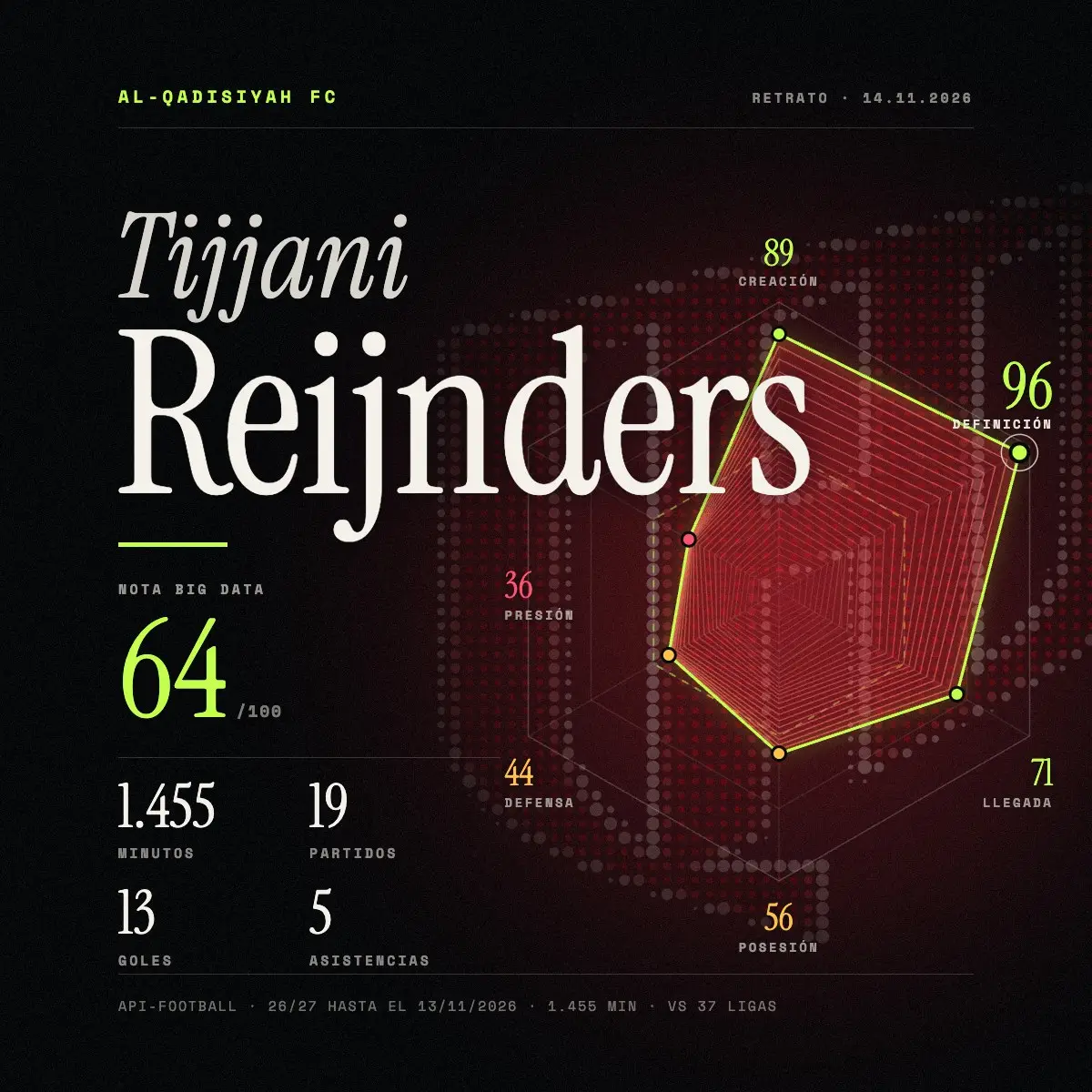
Reijnders did not land in Saudi Arabia at his best. At City he lost his place in the second half of the season, Ronald Koeman kept him on the bench the day Morocco knocked the Oranje out on penalties and, in August, Enzo Maresca left him out of the Community Shield squad. The English club sold him to Brendan Rodgers' Al-Qadisiyah for around 52 million pounds. By November, he is the top scorer of Xavi's side: four goals and an assist in five matches, only one of them as a substitute. Against Greece he needs 21 minutes to score three times before half-time, something no Dutch player had done since Marco van Basten in 1990.
Four of the seven goals against Greece come from boots that compete every week in Saudi Arabia
In Al Khobar he keeps up the pace: eight goals and three assists in ten matchdays, joint third in the scoring charts with Cristiano Ronaldo and behind only Ivan Toney. No midfielder in the league scores more. Nor is he alone in Amsterdam: Crysencio Summerville, who left relegated West Ham for around 60 million pounds, has started all five of Xavi's matches and opened the rout after six minutes.
That is what sets it apart from China. For many, the Super League was an end-of-career destination: the salary arrived, but the spotlight faded. The Saudi championship is starting to tell a different story. Since August, 54 foreign players based there have made a matchday squad for their homeland, from 34 countries, and 46 have actually taken the field. João Félix, the tournament's leading provider with eight assists, has netted three times in four Nations League outings for Portugal; Darwin Núñez has matched that tally in as many friendlies for Marcelo Bielsa's Uruguay; Yassine Bounou is still Morocco's goalkeeper and Sergej Milinković-Savić remains a fixture for Serbia.
Nor is it an elephants' graveyard any more. George Ilenikhena joined Al-Ittihad in February, aged 19, for around 30 million euros paid to Monaco; he has six league goals and in September made his Nigeria debut by scoring against Madagascar. Christopher Baah, 21, has seven assists this season alongside Reijnders and has already worn the Ghana shirt. In that dressing room Mohammed Abu Al-Shamat and Musab Al Juwayr are growing up, Saudi internationals aged 24 and 23 who took part in the 3-2 win over South Korea that same Friday. It is the least visible side of the plan: local talent learning next to the men who call the shots for their national teams, with 2034 on the horizon.
For anyone in doubt, Reijnders is proof that you can leave without disappearing
The argument has its cracks. Ollie Watkins, with a Big Data Rating of 82 —25th among the 2,787 attackers in the 37 leagues we analyse—, has not made a single Thomas Tuchel squad since September. Toney, the division's top scorer with thirteen goals, has not either. Mateo Retegui, Reijnders' teammate, has been absent from Italy's squads all autumn. Saudi Arabia offers minutes and numbers, but the passport is signed by the national coach. That is why the midfielder's case carries so much weight: a leader of the Oranje who keeps his place and, when he goes home, scores more than anyone turns the risk into an argument.
On Monday in Berlin, Germany and the Netherlands play for top spot in the group. If Reijnders takes charge again, the Saudi league will have won something no transfer can buy: the trust of a coach who said he wanted the ball and who hands it to a footballer who competes in Al Khobar.
Data: API-Football, 2026/27 season up to 13/11/2026 (Saudi Pro League, AFC Champions League, Nations League, Africa Cup of Nations qualifying and friendlies; squads are each match's starters and substitutes as provided by the API). Big Data Rating and percentiles: Al Primer Toque, against players in the same position across the 37 leagues we analyse. Reijnders' sample: 1,455 minutes (839 in the league, 276 in Asia and 340 for his national team). Press: Al Jazeera, ESPN, beIN Sports, CNN, France 24 and The National.